2026's Heatwave Potpourri
📍 Cambridge, EnglandAssorted notesSome notes from the heatwave.
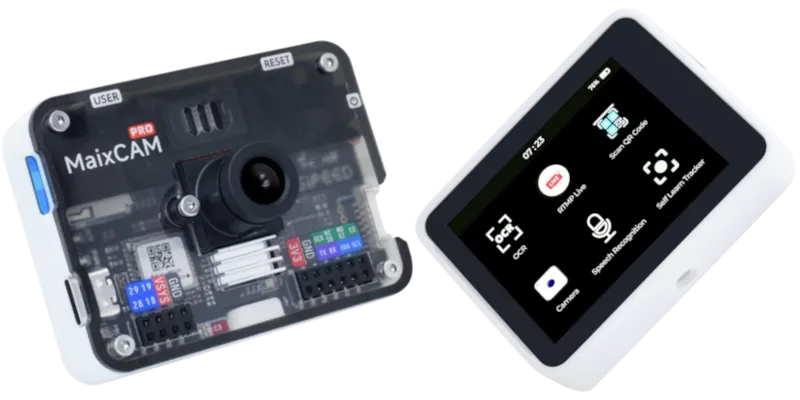
Using MaixCam Pro
I picked up one of these as part of research work and I'm also pleasantly surprised at how easy it is to use. Note that it is still a development kit. It's not production hardware, but it could be.
OS
It runs a BusyBox environment on
Linux including an SSH server, so you can indeed ssh into it from
over the network.
ssh root@maixcam.local # Default password is root
SCP works too. By default the root user has access to a models/ directory
containing a load of trained models, but going back into / gives you access
to maixapp/, which allows you to sideload your own apps.
Python
It uses the MaixPy library, which is pretty neat, and you can write computer vision classification wrappers in it.
From the GitHub.
from maix import camera, display, image, nn

classifier = nn.Classifier(model="/root/models/mobilenetv2.mud")
cam = camera.Camera(classifier.input_width(), classifier.input_height(), classifier.input_format())
disp = display.Display()

while True:
    img = cam.read()
    res = classifier.classify(img)
    max_idx, max_prob = res[0]
    msg = f"{max_prob:5.2f}: {classifier.labels[max_idx]}"
    img.draw_string(10, 10, msg, image.COLOR_RED)
    disp.show(img)
A package, at its most basic, looks like:
app/
 |-- app.yaml
 |-- main.py
I'd love to see a imgui though. This could be neater. I don't like that it uses a systemwide install of the MaixCam library. This is where uv can be used.
# Build Python package to dist/
$ uv build

# Send it to maixcam device over scp
$ scp -r dist/ root@maixcam.local:/maixapp/apps/your-app/
It's worth noting that there's also a C/C++ library available. I'd love to see a imgui though.
Other cool things
-
PicoClaw runs on a MaixCam Pro! Just don't expect it to run a language model particularly well, you will still need an API key and an inference service.
-
It's worth remembering that this device is a RISC-V device with a neural network accelerator. If it compiles to RISC-V, there's a good chance it could run. Have a look at the PicoClaw repository to see how PicoClaw does this.
-
I haven't tried the MaixVision IDE but it looks decent.
-
The Plaza shows some pretty cool uses for this.
Using an immutable root OS
After the AUR debacle, I decided to move over to an immutable root OS. It did mean I had to change my workflow.
-
I containerised a lot of my projects. If a tool wasn't available to install in my user, I had to either find it on brew or just use a container. Case in point: pandoc and LaTeX.
-
I'm still not sold on devcontainers. Sorry! You might as well just have a containerised application similar to how you would have a containerised application on prod.
-
Flatpak isn't too bad. Sacrilege, but it doesn't bother me too much that it's pretty much an app store. At least Flatpaks can't access absolutely everything.
I found Project Bluefin to be perfectly adequate. Full-disk encryption as standard. Transparent updates. It doesn't "hide things" from you, but it does prevent you installing things as root. It's a reasoned compromise. I like Arch, Arch has done a lot for the community, but I don't really have much desire to nanny Arch when updating things.
Containerising LaTeX
I currently use a immutable root operating system, which means I can't install any packages to the root, and must either use Homebrew and user-local package managers, or use a container.
I'm writing a dissertation, and in academia you use LaTeX. Which isn't in
Homebrew. I don't want a nest of binaries in my home directory, so I opted
for a containerised LaTeX. I already had a Makefile containing what LuaLatex
command I need, so I just want a way of running this inside a container.
# Pull the latest blang/latex container with LaTeX on it
$ docker pull blang/latex:latest

# Run it
$ docker run \
    --mount "type=bind,src=$(pwd),dst=/data" \
    -it blang/latex \
    make build
Done!
Recommendations for GIS tooling
I spent some time playing with kepler.gl. Pleasantly surprised at how performant it is on my old ThinkPad connected to a 4K display. If there's one concern it's how to version data between users, but that's not enough for me to discourage it. I would use this over other hosted services.
I'm also passing on SpatiaLite in favour of DuckDB for spatial work. It's quite simple. I still think PostGIS is better, but not everyone can stand up a PostGIS server.
Now's also a good time to ditch Jupyter in favour of Marimo.